

Work-Life Balance Is a Myth: Why True Entrepreneurs Should Stop Pretending
Is work-life balance a noble goal or a fantasy? For many small and medium-sized enterprise (SME) owners and franchise entrepreneurs, the notion of neatly partitioning “work” and “life” can feel like a cruel joke. While a typical European employee works about 36 hours per week, nearly half of entrepreneurs put in over 50 hours weekly, and a staggering 79% of business owners admit they are working too much.
This post tackles the controversial idea that “work-life balance” is largely a myth for entrepreneurs, and why it might be healthier to stop pretending otherwise. We explore the promise versus the reality, backed by data and real-world examples, and ultimately present a more realistic path forward: work-life integration.
The Allure of Work-Life Balance (and Why We Crave It)
It’s easy to see why work-life balance became a buzzword. Research links balanced working hours to better health, productivity, and happiness. When companies pilot a four-day workweek, up to 78% of workers report feeling happier and less stressed. This translates to tangible benefits like lower burnout rates and improved decision-making.
Entrepreneurs are drawn to this ideal. A recent study found that over half of franchisees worried about work-life balance even before opening their business; it was their top concern. The promise of entrepreneurship is autonomy, and most business owners say they have more flexibility than in their prior careers.
In franchise systems, work-life balance is often touted as achievable, with built-in support and proven systems that can reduce the owner’s day-to-day strain. Efficient systems and competent teams allow franchisees to spend less time on management, freeing up time for personal pursuits. That’s the dream, but what’s the reality?
Reality Check: Why Balance Feels Like a Myth for Entrepreneurs
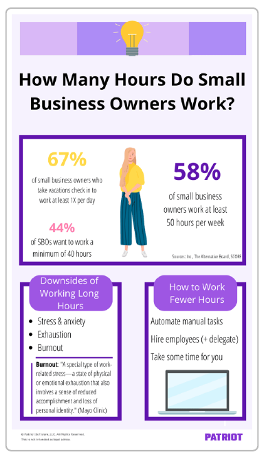 Once the rubber meets the road, many entrepreneurs discover that “balance” is more concept than reality. A business doesn’t clock out at 5 PM. The data illustrates this clearly; nearly half of small business owners work over 50 hours per week, with one in five working over 60 hours.
It’s not just long weekdays; work seeps into weekends and holidays. A majority of business owners work at least one day on the weekend, and most admit they check work messages daily even while on vacation. The very idea of a “day completely off” becomes foreign when you’re in charge.
Why is this so common? Small business owners wear many hats: manager, marketer, bookkeeper, and customer service rep all at once. The pressure leads many to feel that “always being on the job” is their biggest challenge. Nearly half say the inability to step away is the hardest part, and over a third identify balancing work and family as a top concern.
There’s also a cultural factor. The startup community often glorifies “hustle culture.” Tech icons like Elon Musk have famously said that “nobody ever changed the world on 40 hours a week,” advocating 80-hour workweeks. Many entrepreneurs internalise the idea that if you’re not grinding, you’re falling behind.
Crucially, business ownership blurs the line between work and personal identity. When you pour your heart into a venture, it’s not “just a job,” it’s a part of you. That makes it harder to switch off. True work-life balance may be possible for employees, but for entrepreneurs, it is rare and fleeting.
The High Cost of Chasing Balance (Stress, Burnout & Sacrifices)
The irony is that striving for perfect balance can make entrepreneurs feel worse. When you’re told balance is the key to happiness yet you’re unable to achieve it, you end up feeling guilty. This guilt piles on top of the already immense stress of running a business.
Nearly nine in ten entrepreneurs report dealing with significant mental health challenges such as anxiety, stress, or burnout. Chronic overwork strains personal relationships. Many business owners acknowledge a “lifestyle cost”: missed family dinners, neglected friendships, and postponed vacations. In one poll, nearly half of franchisees said they would hesitate to open a second location because they wanted more family time.
Yet, despite these hardships, most entrepreneurs wouldn’t trade it. A majority say running their business is more rewarding than they imagined. Many actually want to work 40 plus hours because they find purpose and passion in their work. The goal isn’t to avoid work, it’s to avoid burnout and resentment.
Beyond the Myth: Embracing Work-Life Integration and “Seasons”
If traditional work-life balance doesn’t fit, what’s the alternative? Many experts now advocate “work-life integration” or viewing life in “seasons” rather than daily balance.
The premise is simple: stop trying to completely separate work and life; instead, blend them intentionally. Integration means designing a schedule where both coexist harmoniously. Maybe you take a two-hour break in the afternoon for family time, then log back on at night. Maybe a “vacation” includes checking emails briefly in the morning, and that’s fine if it eases your mind.
Another useful mindset is viewing life as having different seasons. There will be seasons of intense hustle, such as launching a new product or opening a franchise, and seasons where personal life takes priority. A healthy business allows you to ebb and flow without guilt. Successful franchise owners often find that while the first year requires full immersion, later years offer flexibility as systems mature and teams stabilise.
Entrepreneurs who thrive long term learn to “embrace the season” they’re in, leaning into business growth when needed, and family or recovery when life calls for it. This approach promotes sustainability and mental health.
Strategies for a Healthier Entrepreneurial Life (Work Smarter, Not Just Harder)
Here are practical steps entrepreneurs can take to improve their work-life equation:
- Leverage Technology & Automation: AI tools and automation can reclaim hours each week. Small retailers use AI chatbots for after-hours customer service, and contractors use scheduling software to cut administrative time. Work smarter, not harder; let technology handle the repetitive work.
- Delegate and Build a Trustworthy Team: If you’re doing everything yourself, your hours will always be maxed out. Hiring and training capable people frees you from daily fires. Start small, delegate routine tasks, and build up to larger responsibilities.
- Set Boundaries (Even Flexible Ones): Integration doesn’t mean chaos. Define rules like “no work calls during dinner” or “Sundays are family days.” Communicate them clearly to your team and clients so you can recharge without guilt.
- Tap into Peer Networks or Mentors: Entrepreneurship can be isolating. Joining peer groups or industry associations provides support and perspective. FMS Europe helps entrepreneurs design operational systems that reduce day-to-day stress, allowing business owners to focus on growth instead of firefighting.
- Revisit Your Business Model: If you’re perpetually overwhelmed, consider restructuring. Could you systematise or adopt a semi-absentee model? Many franchise owners find success with B2B service concepts that operate within business hours and don’t dominate evenings or weekends.
These strategies won’t create perfect balance, but they can meaningfully improve your quality of life and reduce burnout. The aim is harmony, a sustainable rhythm where work and personal life complement each other instead of colliding.
Conclusion: Redefine the Balance on Your Terms
The truth is that for true entrepreneurs, the ones passionately building something, work-life balance in the traditional sense will always be elusive. And maybe that’s okay. It’s time to stop pretending entrepreneurs can compartmentalise work and life like employees. Instead, define balance on your own terms. That might mean long hours balanced by immense fulfilment, an unconventional schedule that prioritises family midweek, or a slower growth path that preserves peace of mind.
Ultimately, work-life balance for entrepreneurs isn’t a formula, it’s a mindset. It’s about making choices aligned with your values and being honest about the sacrifices involved. Don’t chase a fantasy of having it all, focus on having what matters most, when it matters most. As your business evolves, so will your equilibrium. Balance is dynamic, not static.