

Introduction
When people talk about franchise opportunities, they often focus on surface-level features: industry, initial investment, territory availability, or whether the concept is “trending”. But franchisees—especially experienced operators and multi-unit buyers—tend to make their franchise investment decision using a deeper filter.
In practice, most franchise recruitment outcomes (and many long-term franchise outcomes) can be traced back to three decisive factors that sit underneath everything else:
The Story — A brand narrative that gives the opportunity meaning, clarity, and momentum—something a franchisee can believe in and sell locally.
Trust in the founder (and the franchisor) — Confidence that the people behind the brand are competent, transparent, fair, and built for the long run—not just great salespeople.
Strong unit economics — A model that works on paper and in reality across real sites, real labour markets, and real cost structures—after royalties, marketing, and operating friction.
These three factors resonate particularly strongly in Europe [1], where market entry is fragmented by country, consumer trust is often hard-won, and candidates have a wide range of established systems to compare against. For context, the United Kingdom [2] alone reported 1,009 franchise systems and 50,421 franchise units in 2024. [3] In the Netherlands [4], the national franchise association reports 928 franchisors (franchise formulas), 34,935 outlets, and franchise turnover of roughly €48.2 billion in 2024. [5] In Germany [6], the national franchise association reports franchise economy turnover around €149.2 billion in 2024, with 148,577 franchise partners—figures that point to a very mature, competitive operator market. [7]
This article is designed to be the most practical, “real world” guide you can hand to:
- founders and SMEs learning the psychology of recruitment and why good candidates say yes (or no),
- franchisors refining their recruitment message and qualification process,
- prospective franchisees evaluating franchise brands with a structured lens.
It is European-centric in data and implications, but uses examples from anywhere when they illustrate the underlying dynamics clearly.
Why franchisees invest emotionally and financially
A franchise is not a normal purchase. It is usually one of the largest “whole-life” investments a person makes—financially, operationally, and psychologically.
A typical franchisee is not only buying a set of manuals and a logo. They are buying:
- a path to entrepreneurship with (in theory) reduced risk versus starting from scratch,
- a set of capabilities they may not have (brand, training, systems, suppliers),
- belonging (to a network and a mission), and
- an identity shift: becoming “the person who runs this brand in this market”.
That is why franchisees invest both emotionally and financially. The moment the investment includes identity, autonomy, and reputation—not just money—franchise choice becomes as much about belief and trust as it is about spreadsheets.
This is also why evaluating franchise brands often looks different from evaluating normal business acquisitions. The International Franchise Association [8] explicitly encourages prospective franchisees to do structured evaluation: studying disclosure materials where relevant, talking with current and former franchisees, and assessing the franchisor’s support and business model. [9] Even in jurisdictions without a single statutory disclosure format, ethical frameworks in Europe emphasise transparency and accurate pre-contract information—because it is the only way an independent entrepreneur can make a defensible decision. [10]
A useful mental model is to think of franchise choice as a three-layer decision:
- Layer one: “Can I believe it?” That’s Story.
- Layer two: “Can I trust them?” That’s founder and franchisor credibility.
- Layer three: “Can I make money with it?” That’s unit economics.
If any layer collapses, the system struggles—either at recruitment (franchisees don’t sign), at ramp-up (franchisees open but don’t thrive), or at retention (franchisees disengage, conflict rises, and the brand’s reputation weakens).
The rest of this article breaks down each factor—and then shows how successful franchise systems align them into a coherent recruitment engine.
Factor one: The Story
A franchise brand’s story is not a “nice to have”. It is a recruitment asset and a performance lever.
What “Story” means in franchising
In this context, Story is not a founder biography or a marketing slogan. It is a structured narrative that answers three questions:
- Why does this brand exist? (the customer problem and the belief behind the solution)
- Why will it win here? (what makes it distinct and durable in a local market)
- Why is it a franchise? (why independent entrepreneurs are essential to the mission and model)
In franchising, story matters because candidates face uncertainty. They cannot fully observe the quality of the franchisor’s support, the real enforceability of standards, or the true strength of unit economics until after they commit. Strong stories reduce that uncertainty by creating meaning and legitimacy.
This isn’t just intuition. Research into entrepreneurial pitching has found that including a founding or origin story can increase the likelihood of funding success in pitch settings—because narratives help establish legitimacy and reduce uncertainty. [11] While franchisees are not venture capitalists, the psychological mechanism overlaps: story helps a decision-maker make sense of risk and imagine a credible future.
Why story converts interest into action
In the early stages of a franchise investment decision, franchisees ask themselves (often subconsciously):
- Will customers understand this brand quickly?
- Can I explain it in one sentence?
- Does it feel modern, relevant, and defensible?
- Can I recruit staff to it?
- Can I sell it locally without constant discounting?
Story is how you answer those questions without talking about your internal process manual.
This is why high-performing franchise systems invest heavily in clear brand identity and recognisable positioning before (or alongside) expansion. Academic syntheses of franchising and brand benefits note that strong brands do more than attract consumers—they can function as signals of quality (and even of network strength) in contexts where information is imperfect. [12]
What story looks like to a franchisee evaluating franchise brands
For a franchisee, “a good story” usually feels like:
A clear “why now”
Something in the market has changed (consumer needs, digital behaviour, demographics), and the brand is built for this moment—not just “we’ve been around for years”.
A customer promise that travels
The best franchise stories can be told in any city: the concept has meaning beyond one neighbourhood.
A mission that makes franchisees proud
Not only “earn money”, but “build something that matters”.
Proof that the story is real
Not hype—evidence. This might include national survey indicators, performance data in disclosure-grade materials, credible testimonials, and repeatable customer outcomes.
One subtle but crucial point: story without operational truth backfires. If the narrative promises a premium experience but operations cannot deliver consistently, the story becomes a liability because it increases customer expectations the system cannot meet.
Practical story-building for franchisors
A franchisor can pressure-test their story with three questions:
1) Can a franchisee retell the story accurately after one conversation? If not, it’s too complex or too founder-centric.
2) Does the story explain why franchising is the right vehicle? If the story doesn’t imply distributed entrepreneurship, franchising can feel like a financial tactic, not a mission.
3) Does the story align with the economics? A premium story must support premium pricing. A value story must support high-volume efficiency. Misalignment makes unit economics harder.
Your story is the first filter that drives inbound quality. Strong story attracts aligned candidates; weak story attracts bargain hunters and “any-opportunity” buyers—which creates long-term cultural and compliance risk.
Factor two: Trust in the founder and the franchisor
If story opens the door, trust determines whether a franchisee walks through it.
In franchising, the franchisee is legally independent. They bear local labour risk, local lease risk, and often personal financial exposure. They are effectively betting that the franchisor will remain competent, fair, and supportive for years—sometimes decades. That is why franchise recruitment is not only sales; it is trust creation.
Trust isn’t soft: it predicts behaviour that drives performance
Research in franchising repeatedly links trust to behaviours and attitudes that directly affect system performance.
A study on trust in franchise organisations examined how trust affects key franchisee attitudes and behaviours such as satisfaction, identification with the franchisor, compliance, and perceived relationship quality—variables that are repeatedly associated with franchise performance outcomes. [13]
Other work has investigated the interaction between standardisation requirements and trust, exploring how trust shapes franchisee attitudes and behaviours in growing franchise systems. [14] More recent research has even examined trust congruence between franchisor and franchisee as a driver of network outcomes. [15]
The pattern is consistent: trust is not “nice”. It is a measurable predictor of whether franchisees will:
- follow standards without constant enforcement,
- communicate early when problems appear,
- invest in marketing and quality rather than cutting corners,
- engage with support, and
- become advocates (or critics) in recruitment conversations.
What franchisees mean by “trust in the founder”
When franchisees talk about trusting the founder, they rarely mean “liking them”. They mean:
Credibility
Does the founder (or leadership team) understand the business deeply, including the hard operational realities?
Transparency
Do they disclose limitations, risks, and learning curves—or do they only sell upside?
Consistency
Do they make decisions based on data and principles, or mood and short-term pressure?
Fairness
Do they treat franchisees like partners, or as revenue sources?
Long-term commitment
Are they building an institution—or running a short-cycle franchise sales campaign?
European ethical frameworks underline these expectations explicitly. The European Code of Ethics for franchising (as promoted and referenced by European and national associations) emphasises good faith and fair dealing, and sets expectations around truthful recruitment communications and proper franchise relationships. [10]
How franchisors accidentally destroy trust in recruitment
In recruitment, trust is often lost through predictable behaviours:
Overselling early-stage economics
Cherry-picked sites, unrealistic labour assumptions, or “best case” projections without sensitivity analysis.
Vague support promises
Statements like “we’ll help you with marketing” without specific deliverables, tools, and cadence.
Inconsistent answers
If two candidates get different explanations, candidates assume the franchisor is improvising.
Defensive posture
If the franchisor reacts negatively to hard questions, candidates interpret it as insecurity or lack of transparency.
The irony is that many franchisors lose trust because they fear losing the sale. But the franchisees you most want—strong operators with capital and experience—are usually the ones who test you hardest. They interpret your response to scrutiny as a signal of how you will behave after signing.
Trust-building practices used by high-performing franchisors
The most consistent trust-building behaviours in strong systems include:
Disclosure-grade clarity
Whether or not a country mandates an FDD format, strong franchisors provide written clarity about:
- fee structure and obligations,
- what support actually includes,
- what the franchisee must do to win,
- what the franchisor will not do, and
- how performance is monitored and improved.
Evidence over persuasion
Instead of “trust us”, they show:
- unit economics ranges,
- performance drivers,
- operational KPIs,
- training pathways,
- support calendars, and
- real franchisee references.
A founder who behaves like a steward, not a hero
Founders who build trust typically communicate in systems language:
- “Here’s how we do it and why,”
- “Here’s what we learned,”
- “Here’s what is still being improved,” and
- “Here’s how we handle disagreement.”
This aligns directly with what franchisees want: predictability and institutional maturity.
Factor three: Strong unit economics
Even the best story and highest trust cannot compensate for weak economics. Franchisees might sign because they believe in you, but they stay (and scale) because unit economics work.
In other words: story attracts, trust converts, economics retains.
Why unit economics is the non-negotiable core
Franchisees typically evaluate unit economics because:
- Their upside comes from unit-level cashflow (and eventually resale value).
- Their downside often includes personal guarantees on leases, loans, and equipment.
- Their time investment is high: many franchise concepts are operational businesses, not passive investments.
- Economic pressure is what triggers most system-damaging behaviours: corner-cutting, breakage of standards, conflict over fees, and disengagement.
European markets make unit economics particularly sensitive because cost structures vary heavily by country and city:
- labour and social cost burdens differ,
- property costs and lease norms differ,
- VAT treatment can affect price perception and demand,
- consumer habits differ (e.g., pre-booking vs walk-in, delivery vs pick-up, subscription vs single purchase).
So what counts as “strong unit economics” is not a single number—it is a model that remains viable under local variance.
What franchisees actually want to see when evaluating unit economics
When franchisees are evaluating franchise brands, the most serious candidates do not ask “what’s the average profit?” They ask questions like:
- What is the typical revenue ramp over the first 6–24 months?
- What are the main drivers of demand (marketing channels, referral rates, repeat frequency)?
- What are the controllable cost levers (labour, scheduling, supply, waste, local marketing)?
- What fixed costs dominate (rent, required staffing, equipment finance)?
- How sensitive is profit to wage inflation or rent increases?
- How does the franchisor help protect margin (procurement leverage, pricing guidance, process efficiency)?
A key insight from franchise performance literature is that franchisee performance is influenced by franchisor-related factors (including brand reputation and system profitability) and relationship factors—suggesting unit returns are not only “operator skill” but also system design and support outcomes. [16]
A European reality check: profitability claims must be handled carefully
Industry surveys can be useful as context—but should not be treated as guarantees for any specific franchise system.
For example, the UK’s national survey outputs (as compiled in industry materials) indicate sector contribution around £19.1bn, average turnover per unit around £400,000, and a reported 89% of franchised units being profitable. [17]
Those figures are powerful indicators of the sector’s maturity and potential, but they are not proof that any individual franchise opportunity will be profitable. They are aggregated survey results and depend on methodology and respondent mix. [18]
A franchisor that builds trust will use sector data ethically: as context, not a promise—and as a prompt to show its own unit economics transparently.
The “unit economics stack” franchisees evaluate
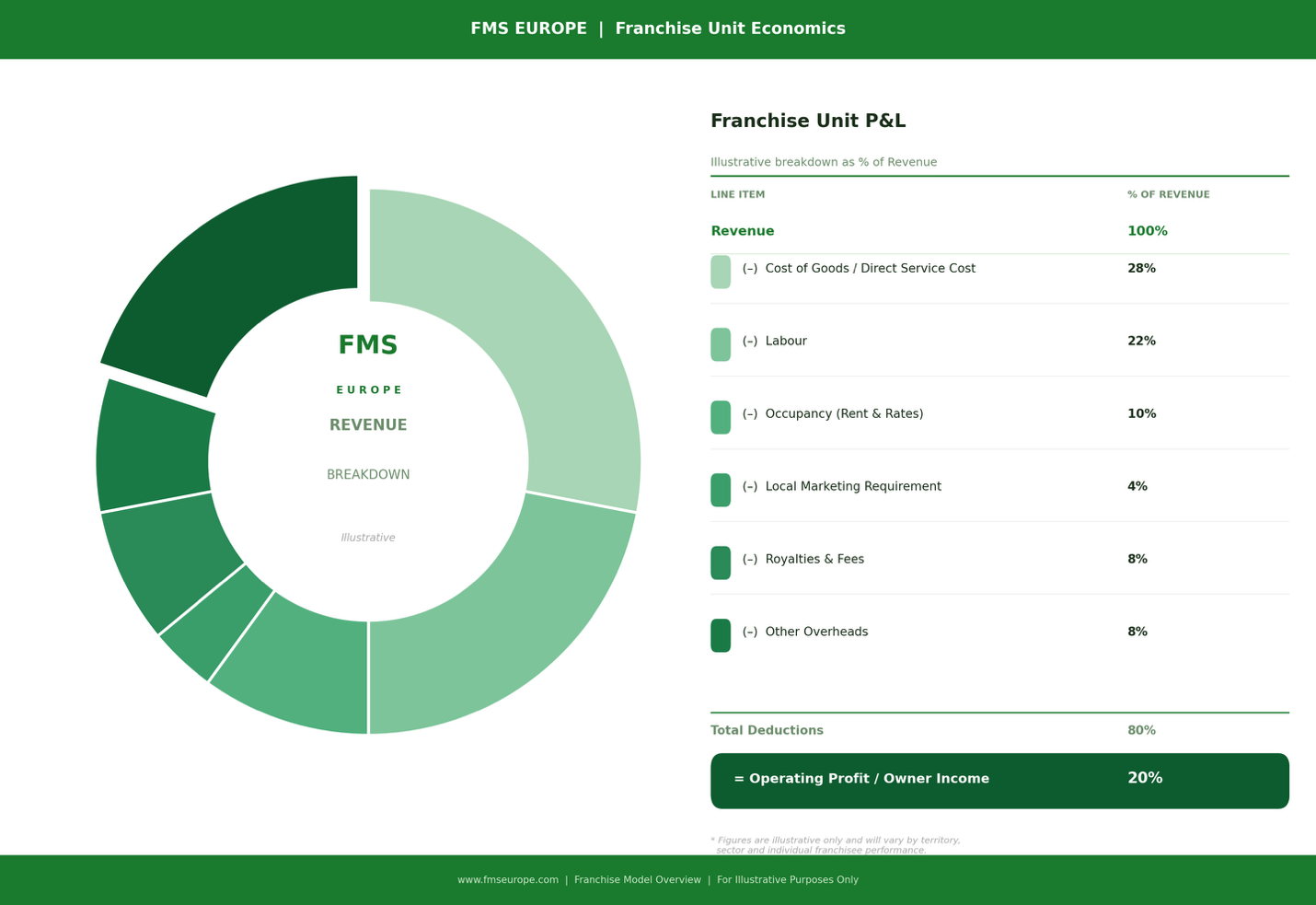
The franchisee then tests the stack against reality: – recruitment difficulty, – staff turnover, – seasonality, – local competitive pricing, – lead generation costs, – and compliance obligations.
This is where many franchisors unintentionally create friction: they price royalties and fees as if they are independent of unit economics, rather than funded by them. Successful systems align fee structures with genuine support value and sustainable unit returns.
How the three factors drive franchise recruitment and system success
Here is the greatest misunderstanding in franchise development:
Founders often believe recruitment is mainly about marketing the opportunity. Franchisees behave as if recruitment is mainly about de-risking the decision.
Story, trust, and unit economics are the franchisee’s de-risking framework.
The franchisee choice funnel
A practical way to see the role of each factor is to map them to the franchise recruitment journey:
Attention and interest: the story does the heavy lifting
Most candidates first encounter you through a short signal: a website, a brand impression, a referral, or a listing. Story determines whether they lean in or scroll past.
Consideration: trust becomes dominant
Once candidates request information, speak to your team, and start comparing options, trust becomes the deciding factor—because they are now assessing your professionalism, your transparency, and your maturity.
Commitment: unit economics must survive scrutiny
At the point of signing, economics becomes the final gate: the candidate must believe the risk is justified by returns.
Performance and retention: all three must stay aligned
After opening, the story must translate into customer demand, trust must translate into effective support and governance, and economics must translate into sustainable cashflow.
How successful franchise systems align the three factors
Strong systems do not treat story, trust, and unit economics as separate “departments” (marketing, sales, ops). They align them as one coherent offer.
They typically do four things:
They make the story operational
The brand promise is embedded in training, standards, customer journey design, and marketing assets. The story is not just a pitch; it becomes a method.
They make trust visible
They operationalise transparency with clear documentation, realistic economics, defined support delivery, and ethical recruitment practices aligned with European codes of conduct. [19]
They make unit economics teachable
They do not just show numbers; they show drivers, levers, and decision rules. Franchisees are taught how to protect margin, not merely expected to figure it out.
They choose franchisees who match the system
The best systems aren’t built by signing everyone. They are built by selecting franchise partners whose capabilities and motivations fit the promise and economics of the model.
When these three factors align, something powerful happens: your best franchisees become your best recruiters. They tell the story credibly, reinforce trust through real experience, and validate economics through performance.
Case studies and examples of the three-factor alignment
This section illustrates how real systems embody the “story–trust–economics” triangle. The goal is not to imply these brands are perfect, but to show how the mechanism works.
McDonald’s [20]
Story: McDonald’s story is built around speed, consistency, and an engineered customer experience. Its own corporate history highlights the 1948 introduction of the “Speedee Service System” and notes that their streamlined model led to franchising the concept. [21]
Trust: Standardisation at scale requires training and governance. A widely cited historical summary notes that Ray Kroc created a training programme in 1961 that became known as Hamburger University to ensure standardised operation across outlets. [22]
Economics: McDonald’s long-run economics are anchored in repeatable unit models and a global brand that lowers customer acquisition friction, though unit economics vary by market and format. (The key lesson for emerging franchisors is not “be McDonald’s”, but “make your promise teachable and enforceable” through systems and training.) [23]
Domino’s Pizza [24]
Story: Domino’s brand story has always translated into a simple customer promise: reliable delivery at scale, supported by operational focus.
Trust: For franchisees, trust comes from evidence that the system can replicate performance. Domino’s company history documents that the first franchised store opened in 1967 in Ypsilanti, Michigan—an early indicator of using franchising as a deliberate scaling vehicle. [25]
Economics: Domino’s is often referenced as a system where brand and operations reinforce unit throughput and repeat purchase patterns. The franchise lesson is that a strong, clear promise (“delivery done well”) can translate into predictable demand drivers—which is what unit economics ultimately needs.
Kumon [26]
Story: Kumon’s narrative is mission-driven: developing children’s potential through a structured learning method.
Trust: Its credibility comes from method consistency and long-term institutionalisation. Kumon’s official history records that the first Kumon Center opened in Shinjuku, Tokyo in 1962, demonstrating that the concept was built around a repeatable method rather than a single charismatic operator. [27]
Economics: Education and tutoring concepts depend heavily on local trust and repeat engagement; a strong brand story and method consistency can lower the “trust barrier” for parents, which helps economics. This is an example of story and trust directly influencing customer acquisition cost and retention, two core economic drivers.
Anytime Fitness [28]
Story: Anytime Fitness has a clear, easily communicated promise: convenient access (“anytime”), aligned to modern consumer routines. Its franchise page notes the brand was co-founded in 2002 and has grown to more than 5,000 franchise locations—a signal of scale and maturity. [29]
Trust: In fitness, franchisees scrutinise operational support because customer churn and local competition can be intense. Brand scale can serve as a credibility signal, but trust still depends on real support, training, and enforceable standards—exactly the behaviours trust research links with compliance and relationship quality in franchise networks. [30]
Economics: “Convenience positioning” can support stable demand, but unit economics still hinge on occupancy costs, local competition, staff structure, membership churn, and marketing efficiency. The lesson is that clear story and trust increase the probability of good economics—but cannot replace it.
References
[1] [7] Franchisewirtschaft 2024 – Deutscher Franchiseverband
[2] [16] Performance in Franchise Systems: The Franchisee Perspective – DiVA Portal
[3] [32] The results are out – 2024 National Franchise Survey is live! – British Franchise Association
[4] [13] [26] [30] The role of trust in franchise organizations – Emerald Insight
[5] [31] Franchise statistiek: Feiten en cijfers over franchising – Nederlandse Franchise Vereniging (NFV)
[6] [35] Franchising – European Parliament Study
[8] [29] About the Anytime Fitness Franchise
[9] Making Your Franchise Decision – International Franchise Association
[10] European Code of Ethics for Franchising
[11] [24] Two Studies on the Importance of Founding Narratives to Entrepreneurial Pitch Success – ResearchGate
[12] Franchising brand benefits: An integrative perspective – ScienceDirect
[14] [28] The Effects of Standardization and Trust on Franchisee’s Attitudes and Behaviours – Wiley / Journal of Small Business Management
[15] Trust and Control in Franchise Networks: A Dyadic, Multi-level Study – Sagepub
[17] [18] British Franchise Journal Infographic Highlights – British Franchise Association (UK Franchising 2024: £19.1 billion contribution; 1,009 systems; 50,421 units)
[19] Code of Ethics – European Franchise Federation
[20] [22] [23] McDonald’s | History, Ray Kroc, & Famous Menu Items – Britannica
[21] McDonald’s History – McDonald’s Corporate
[25] [36] Domino’s Complete Company History
[27] Kumon History – Kumon
[33] [34] [38] Franchise Resources Europe | Development Support – FMS Franchise Europe
[37] FMS EU: Expand Your Franchise in Europe with FMS Europe
Closing
If you are exploring whether franchising could work for your business, the team at FMS Franchise Europe works with founders across the UK, Europe, and international markets to develop scalable franchise systems.
You can learn more at www.fmsfranchise.eu or book a discovery call here.